14 Days in Morocco: The Complete Itinerary, and Why It Runs This Way
Two weeks is the first trip length where Morocco stops being a highlights reel. You get the Sahara, both imperial capitals, the Rif, and the Atlantic coast without moving hotels every night.
Most 14-day plans online are a list of cities with drive times attached. That tells you what is possible. It does not tell you why Fez earns two full days while Casablanca earns two hours.
This guide gives you the day-by-day, then explains the reasoning behind it. You will see what each stop delivers, what you can swap out, and where the route bends for your travel style.
By the end you will know whether this itinerary fits you, or whether a different shape of trip fits better.
Quick Facts
- Route shape: A loop from Marrakech, south over the Atlas, east to the Sahara, north to Fez, then the Rif, the coast, and back
- Total driving: Roughly 2,200 to 2,400 km across 14 days
- Longest single day: Merzouga to Fez, about 470 km and 7 to 8 hours with stops
- Overnight bases: 9 in total, with 2 nights or more in Marrakech, Merzouga, and Fez
- Nights in the Sahara: 2, both inside the dunes or only one?
- Cities with guided days: Marrakech, Fez, Chefchaouen, Rabat, Casablanca
- UNESCO World Heritage sites: 7, including Ait Ben Haddou, Fez el-Bali, Volubilis, Meknes, Tetouan, Rabat, and the Marrakech medina
- Best months: March to May and September to November
- Hardest months: July and August in the desert, January nights in the Rif and the dunes
- Typical site entry: 70 to 150 MAD ($7 to $15) per major monument
- Out-of-pocket budget: Roughly 300 to 500 MAD ($30 to $50) per person per day for lunches, entries and tips
- Airports: Start and finish at Marrakech (RAK), or finish at Casablanca (CMN) on request
- Best for: First-time visitors who want the desert and the cities without rushing either
- Not ideal for: Beach holidays, surf trips, or High Atlas trekking
Distances are approximate and vary with stops. Site entry fees rose across Morocco in recent years, so confirm current prices before you travel.
The Day-by-Day Itinerary
Day 1: Marrakech, First Orientation
You start with a guided day covering three sites. Begin at Jardin Majorelle in the first hour after opening. The garden is cooler then, and the cobalt walls read better before the midday glare flattens them.
Continue to the Saadian Tombs, the 16th-century royal burial ground that stayed sealed until 1917. That is precisely why the carved plaster and marble survived intact.
Lunch in the medina, then the Koutoubia Mosque and its 77-metre minaret. The evening is yours at Jemaa el-Fna, which is worth seeing after dark when the food stalls and storytellers take the square.
Overnight in a riad in Marrakech.
Day 2: Marrakech, Gardens, Palaces and Souks
A second guided day, starting at Le Jardin Secret, a restored 19th-century palace garden. The old khettara channels still feed the beds, which is the clearest surviving demonstration of how the city was watered.
Then Bahia Palace, or El Badi Palace if you prefer open ruins to decoration. Lunch in the medina, then the souks for spices, carpets, lanterns, ceramics and leather.
The afternoon leaves time to walk the old medina at your own pace. Free evening at Jemaa el-Fna, overnight in Marrakech.
Day 3: Marrakech to Ouarzazate, Over the Atlas
Leave early and climb the Tizi n’Tichka pass at 2,260 metres, the highest paved pass on Morocco’s main road network. Stop at the roadside mineral and fossil stalls near the summit. The quartz and ammonites are real and the prices are fair, so carry small cash.
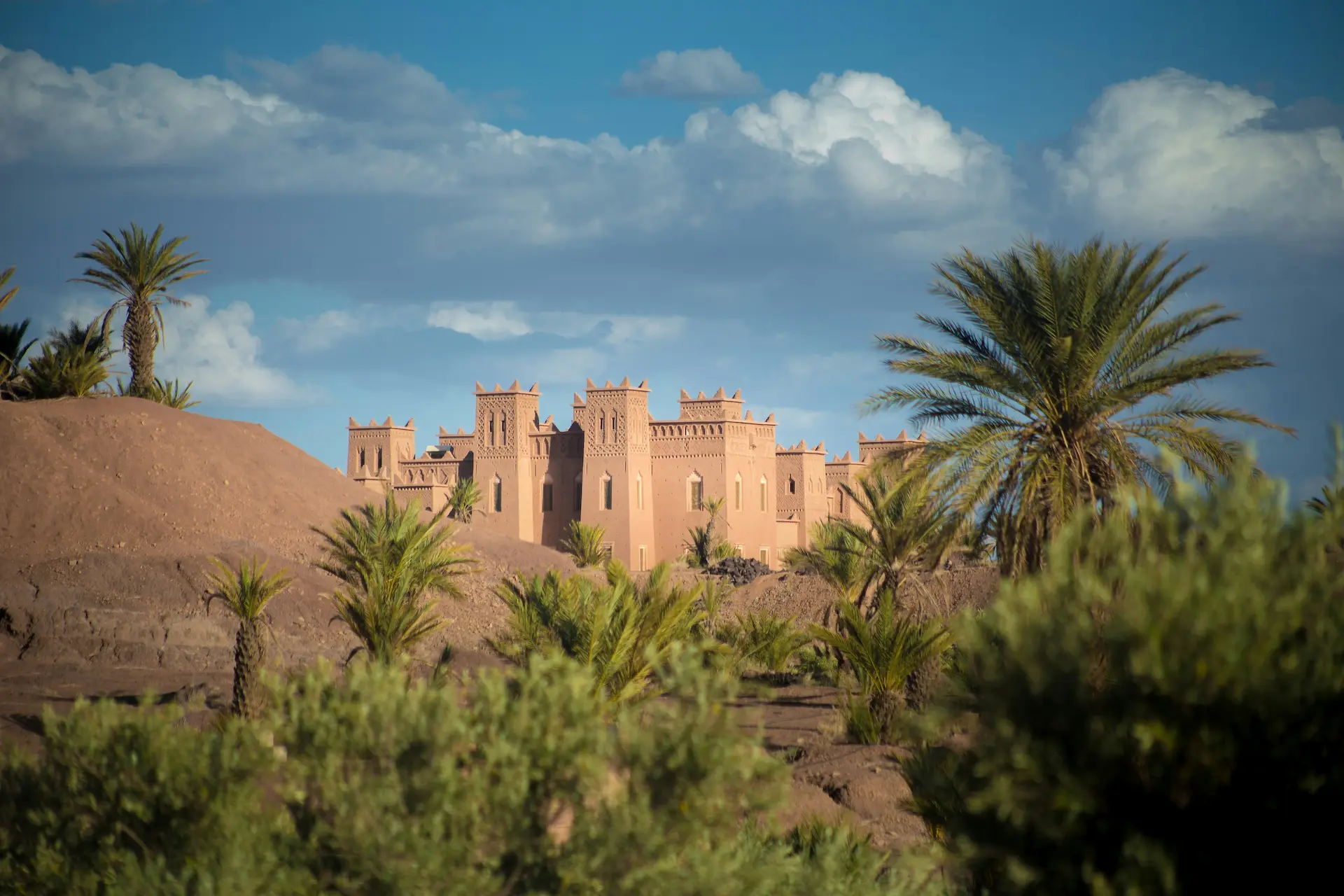
Continue to Ait Ben Haddou for a guided walk through the ksar. A local guide explains how Amazigh families built the earthen towers to defend the caravan route below.
You will recognise it from Gladiato and Game of Thrones. Lunch near the ksar, then the Taourirt Kasbah in Ouarzazate. Dinner in town, overnight in a lodge.
Day 4: Ouarzazate to Merzouga, Into the Dunes
Drive east through the Skoura oasis, where earthen kasbahs stand among the palm groves. Stop at the Dades Gorge for the switchbacks and the rock formations known as Monkey Fingers.
Continue to the Todra Gorge, where the walls close to around 10 metres apart and rise 300 metres. Walk a short stretch beside the cold stream. The temperature drop inside the canyon is the clearest way to feel how the water cut it.
Lunch at a riverside cafe, then the land shifts from palm groves to scrub to orange sand. A late afternoon camel trek of about 90 minutes carries you into Erg Chebbi as the sun drops.
Dinner is medfouna, the stuffed Amazigh flatbread baked in a clay oven. Drums and fire afterwards, overnight in the desert camp.
Day 5: Merzouga, A Full Day in Erg Chebbi
Wake before dawn and climb whichever dune you like for sunrise, then breakfast at camp. The camp is your base all day, which is the point of this itinerary rather than a single overnight.
A morning 4WD excursion runs while the light is low and the tracks are cool, with a visit to nomad families who move with the seasons. Quad biking and sandboarding are available from the camp.
Lunch at camp, then an afternoon camel ride through the dunes. Dinner, music and stargazing, overnight in the desert camp.
Day 6: Merzouga to Fez, the Long Road North
Sunrise from the dunes, breakfast, then ride the camels back out to the vehicle. This is a full travel day and it works best treated as one, rather than squeezing sightseeing onto the end.
The road runs north through the Ziz Valley, with a panoramic stop above the palm groves and fortified villages. Lunch in Midelt, a town known for its apple orchards.
Climb into the Middle Atlas for a break at Ifrane and the cedar forest, where Barbary macaques gather around an 800-year-old cedar. Keep snacks out of sight, because they are wild and quick. Arrive Fez in the early evening, overnight in a riad in the medina.
Day 7: Fez, Reading the City From Above
Begin at Borj Nord, the 16th-century hillside fortress. Seeing the medina first as one dense field of rooftops and minarets makes the alleys below far easier to read later.
Continue to Dar el Makhzen, the Royal Palace, where the brass doors and cedar surrounds can be admired from the square. Enter Fez el-Bali through Bab Boujloud, the Blue Gate.
Lunch in the medina, then the community cooperatives: weavers, the brass workers at Place Seffarine, and the pottery and zellij workshops where tiles are still cut by hand. End at the Marinid Tombs for sunset, when the call to prayer rises out of the valley.
Day 8: Fez, Inside the Medina
A full guided day inside the largest car-free urban area in the world. Start at the Chouara Tannery, where leather is still cured in stone vats by medieval methods. Morning is right, because the vats are worked early and the terrace light is better.
Continue to Al-Qarawiyyin, founded in 859 and the oldest working university in the world. Then the Bou Inania Madrasa, the Attarine Madrasa and museum, and the Nejjarine Fountain.
Lunch in the medina, then a walk through Fez Jedid and the old Jewish quarter. This shows how the city expanded after the 13th century, with more time in the souks. Overnight in Fez.
Day 9: Meknes and Volubilis, a Day Trip From Fez
Drive to Meknes for Bab Mansour and the Heri es-Souani granaries, whose walls were built thick enough to hold grain cool for Moulay Ismail’s stables. Visit the Moulay Ismail Mausoleum for its zellij and carved stucco.
Continue to Moulay Idriss Zerhoun, the whitewashed holy town spread across two hills. Lunch in Meknes.
Volubilis works best in the afternoon. The low sun brings out the relief in the floor mosaics of the House of Orpheus, still set where they were laid, and the olive presses stand open to the sky. Return to Fez for the night.
Day 10: Fez to Chefchaouen, Into the Rif
Leave after breakfast and drive north past cork oaks and small farms, with a tea and photo stop on the climb. Arrive around midday and leave the vehicle above the medina, since the lanes are cobbled and stepped.
Visit the 15th-century Kasbah and its museum, then a guided walk through the blue medina with time at the workshops where local women weave striped wool blankets. Lunch at Ras El Ma, the spring at the medina’s edge, where the tagine arrives beside running water.
Late afternoon, climb five minutes to the Spanish Mosque for sunset. The light turns the rooftops cobalt and the whole valley opens up. Dinner in the medina, overnight in an auberge.
Day 11: Chefchaouen to Akchour to Tetouan
Drive deeper into the Rif toward Akchour, with stops for valley views as the landscape turns green. Pause in one of the villages to buy bread straight from the community oven, still hot. That is the local way to start a day in the mountains.
Hike through the Akchour valley to the natural pools fed by the waterfall. The path is rocky in places and the round trip runs about two hours. Swim in the cold water or sit on the rocks.
Lunch is tagine and fresh juice beside the water. Return in the afternoon and take the road north to Tetouan, overnight in a riad.
Day 12: Tetouan to Tangier
Drive up to Tangier and walk the medina, where the Kasbah, Petit Socco and Grand Socco sit within minutes of each other. The Andalusian and Spanish influence in the architecture is clearer here than anywhere else in Morocco.
Lunch in the medina, then the Mediterranean shore for a swim if the weather allows, or a walk along the corniche. Late afternoon is the right window, because the light across the strait toward Spain is best in the final hours.
Overnight in a hotel in Tangier.
Day 13: Tangier to Rabat
Take the coast road south to Rabat. Visit the Hassan Tower, the minaret of a mosque begun in the 12th century and abandoned unfinished, with the prayer hall columns still standing in rows.
Alongside it sits the Mausoleum of Mohammed V, worked in onyx, zellij and carved cedar. Walk the Kasbah of the Udayas, the 12th-century fortress whose white and blue lanes look over the mouth of the Bou Regreg.
Finish at Chellah, a Roman town that later became a Marinid necropolis. The two layers sit one on top of the other inside the same walls. Lunch in Rabat, overnight in a riad.
Day 14: Rabat to Casablanca to Marrakech
Drive to Casablanca for a guided visit to the Hassan II Mosque, the only mosque in Morocco open to non-Muslim visitors. It is built out over the Atlantic with a 210-metre minaret.
Morning is the right slot, because the light comes through the glass floors over the water at its best then. Walk on the sand afterwards, or swim if the weather is right.
Lunch on the coast, then the road south to Marrakech. You arrive in the evening for drop-off at your hotel or the airport, and the tour ends.
Why the Route Runs in This Direction
Morocco itineraries fail in predictable ways, and almost all of them come from route shape rather than site selection. This one is built to avoid three specific traps.
The first trap is treating the Sahara as a side trip. Marrakech to Merzouga and back is roughly 18 hours of driving for one night in the dunes. Running the desert as a one-way crossing from Ouarzazate to Fez removes the backtrack entirely.
The second trap is putting Fez before Marrakech. Fez el-Bali is around 9,000 lanes with no cars and no obvious logic on day one. It rewards you far more once Marrakech has already taught you how a medina works.
The third trap is finishing in a city you have already seen. This route pushes north to the Rif and the coast, which most 10-day plans cut, then returns via Casablanca on the fast motorway. The last day is a transfer with one major site attached, not a wasted day.
If you want the reasoning behind Morocco routing in general, our 10-day Morocco itinerary covers the shorter version of the same line.
The Sahara Decision: Two Nights in the Dunes or One
This is the single choice that changes the feel of the trip most, and it is worth understanding before you book.
The default on this itinerary is two full nights at the camp inside the dunes. You arrive from Ouarzazate in the late afternoon with enough daylight for the sunset camel trek, and you stay through the following day. Two sunrises, one full day in the desert, and no repeated transfers in and out of the dunes.
The alternative breaks the journey differently. Night one is at a guesthouse at the edge of the dunes, with a proper bed and a hot shower after the long drive from Ouarzazate. The camel trek runs the following afternoon, and you spend the second night at the camp inside the dunes. You still get the full desert experience. You just arrive to it more rested.
Either way you enter the dunes once and leave once. That matters more than it sounds, because repeated camel transfers eat hours and patience.
Choose two nights inside the dunes if the desert is the main reason you are coming, or if you are travelling for photography and want the early morning light on two consecutive days. Choose the guesthouse first night if you sleep badly in tents, are travelling with small children, or want a comfortable night between two long driving days.
Families with young children usually prefer the guesthouse option, and our guide on whether the Sahara suits kids covers the age question honestly. Our guide to desert camp facilities breaks down what each camp tier actually provides, which is the other half of this decision.
Our guide to desert camp facilities breaks down what each camp tier actually provides, which is the other half of this decision.
What Each Stop Actually Gives You
Drive times tell you whether a route is possible. They do not tell you what you are buying with each night.
Marrakech: The Training Ground
Marrakech is where Morocco introduces itself at full volume. Two days is the honest minimum: one to be overwhelmed, one to actually see things.
Its real function in a 14-day route is preparation. The souks here are organised by trade and easier to navigate than Fez, so you learn the grammar of a medina in a forgiving place first.
Jemaa el-Fna deserves the evening slot it gets. The square was listed by UNESCO for its oral heritage, and the storytellers and musicians only take over after dark.
Ait Ben Haddou and Ouarzazate: The Caravan Route
Ait Ben Haddou is a fortified earthen village stacked up a hillside, and a UNESCO site since 1987. It explains something the desert alone cannot: that this landscape was a trade corridor before it was scenery.
Ouarzazate itself is a working town rather than an attraction. It exists on this route because it splits a long drive and because the Taourirt Kasbah shows how the Glaoui family controlled the passes.
If atmosphere matters more to you than convenience, ask us to move this night to the Dades Gorge instead. You wake beside red rock walls rather than a roundabout.
Erg Chebbi: Two Nights, Not One
Erg Chebbi is a 28 km field of dunes rising up to 150 metres out of flat stony desert. One night gets you a sunset, a dinner and a sunrise, which is roughly 16 hours on the ground.
The second night is what changes it from a stop into a place. You get a full day of low-light 4WD, nomad visits, and time to sit still in a landscape most people only pass through.
If you are weighing whether the desert leg justifies the driving at all, our post on whether a Sahara tour is worth it answers that directly.
Fez: The Reason You Came North
Fez el-Bali is the largest car-free urban area in the world and the oldest continuously inhabited walled medina. Al-Qarawiyyin, founded in 859 by Fatima al-Fihri, is generally cited as the oldest working university anywhere.
Two full days plus the Meknes day trip is not generous, it is correct. Fez is denser and less polished than Marrakech, and it does not open up on a single afternoon.
The Borj Nord opening on day 7 is the detail most itineraries miss. Reading the medina from above first genuinely changes how the alleys feel the next morning.
Volubilis and Meknes: The Layer Underneath
Volubilis was the capital of the Roman province of Mauretania Tingitana, and its floor mosaics are still set where they were laid. Standing over the House of Orpheus is the only moment on this route where Morocco’s pre-Islamic history is physically in front of you.
Meknes supplies the counterweight. Moulay Ismail ruled for 55 years from the 17th century into the 18th, and the scale of Bab Mansour and the granaries is the argument he was making.
Moulay Idriss Zerhoun between them holds the tomb of the man who founded Morocco’s first dynasty in the 8th century. It is a working pilgrimage town, so dress conservatively and keep cameras away from the shrine.
Chefchaouen and Akchour: The Decompression
Chefchaouen was founded in 1471 as a fortress against Portuguese expansion, and the blue came much later. There is no monument you must queue for, which is exactly its role after Fez.
Akchour on day 11 is the only real physical activity in the itinerary. Two hours of rocky path and cold pools resets the trip before the run down the coast.
If hiking is not for you, this is the easiest day to change. Swap it for a slower second morning in Chefchaouen and a longer afternoon in Tetouan’s UNESCO-listed medina.
Tangier, Rabat and Casablanca: The Modern Country
These three days do something the south cannot. They show you Morocco as a functioning contemporary state rather than a heritage landscape.
Tangier carries its International Zone history in its architecture and its Spanish street signs. Rabat is the political capital and stacks Roman Sala Colonia, a Marinid necropolis and a modern mausoleum within a few kilometres.
Casablanca gets two hours because that is what it warrants. The Hassan II Mosque is genuinely extraordinary, the rest is a business city, and the motorway to Marrakech takes about three hours.
When to Travel This Route
The route crosses four climates in fourteen days, so no single month is perfect everywhere. What you are really choosing is which leg gets the good conditions.
March to May is the strongest window overall. Desert days sit in the 20s and low 30s Celsius, the Atlas passes are clear, and the Rif is green from winter rain. Late March through May carries the highest sandstorm risk on the desert leg.
September to November is the close second. The desert heat has broken, the north is still warm enough for the Tangier swim, and Akchour still has water in the pools.
December to February gives you empty medinas and low prices. Desert nights near Merzouga fall close to freezing, and the Tizi n’Tichka pass can close briefly after snow. Build a buffer and read our winter desert guide first.
June to August is the hardest version of this trip. Merzouga passes 45°C and the Fez medina is punishing at midday. If your dates are fixed, our guide to the Sahara in summer covers the timing strategy that makes it workable.
For the full month-by-month picture across every region, see our Morocco month-by-month guide.
Ramadan and This Itinerary
Ramadan moves about 11 days earlier each year and currently falls in the February to March window. The route runs normally, and your guide and driver may be fasting without any change to the schedule.
Two practical effects matter. Many roadside restaurants close during daylight, so lunch stops on the Ouarzazate and Fez driving days need confirming in advance.
Morocco also moves its clocks back one hour for the month. Every sunrise and sunset shifts an hour earlier on the clock, which affects your dune sunrise and the Spanish Mosque timing in Chefchaouen.
What You Can Swap
This itinerary is a starting shape, not a fixed product. These are the changes we make most often, and why.
- Ouarzazate to the Dades Gorge: Better atmosphere on night three, same drive times. Our most frequently requested change.
- Bahia Palace to Ben Youssef Madrasa: If carved cedar and zellij interest you more than palace rooms, the reopened madrasa is the stronger visit.
- Erg Chebbi to Erg Chigaga: Possible, but it breaks the one-way logic. Chigaga sits near M’Hamid, which pulls you back toward Marrakech rather than onward to Fez.
- Akchour to a second Chefchaouen day: Right for anyone who does not want a two-hour rocky hike, or who is travelling in winter when the pools are cold and high.
- Tangier beach to Cap Spartel and the Caves of Hercules: Better in poor weather, and it adds the point where the Atlantic meets the Mediterranean.
- Rabat to Asilah: If you prefer a small whitewashed coastal town with painted walls to a capital city, Asilah sits between Tangier and Rabat.
- Finish in Casablanca: If your flight leaves from CMN, we end there on day 14 instead of driving the final three hours to Marrakech.
Who This Itinerary Suits
Being honest about fit saves everyone a difficult conversation later.
It suits you if this is a first or second trip to Morocco, you want both the desert and the imperial cities, and you accept several long driving days as the price of covering the country.
It suits you if you would rather have two nights in three places than one night in fourteen. The route deliberately slows down at Marrakech, Merzouga and Fez.
Look at something else if your priority is beach time or surfing. Essaouira and Taghazout sit on the Atlantic southwest, which this loop does not touch.
Look at something else if you want serious trekking. Toubkal and the Ait Bougmez valley need dedicated days, not a roadside stop.
Look at something else if long drives genuinely ruin your holiday. Day 6 alone is 470 km. If that is a problem, our one-week Morocco itinerary covers less ground at a gentler pace.
Culture and Etiquette: What Actually Matters
Amazigh, Not Berber
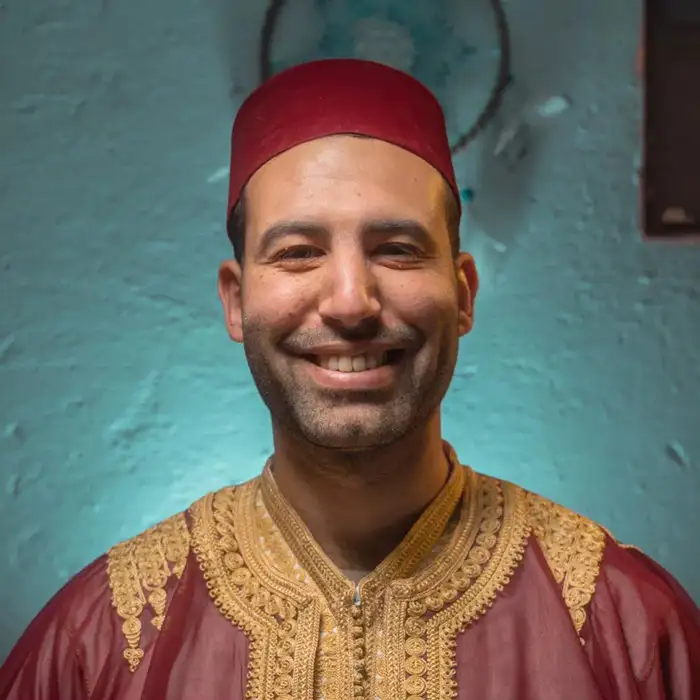
Your hosts in the Atlas, the Dades and the desert are Amazigh, which is the accurate term and the one they use. “Berber” still circulates in tourist English and derives from the Latin for barbarian.
Two words go a long way in the south. Azul is hello and tanmirt is thank you, and using them lands well.
Dress and Behaviour
Morocco is relaxed by regional standards but conservative by European ones. Shoulders and knees covered is the sensible default in medinas, and more so in Fez, Moulay Idriss and Chefchaouen.
Coastal towns and hotel pools are far more relaxed. Public displays of affection draw attention anywhere outside the resorts.
Photography
Ask before photographing people, especially elders and women. At Jemaa el-Fna, performers and animal handlers expect payment, so agree it first or do not raise the camera.
At the Chouara Tannery, the terrace views come with an expectation of a tip. Between 20 and 50 MAD ($2 to $5) is normal and settles it cleanly.
Tipping
Tipping is not aggressive in Morocco but it is expected. Camel guides take 20 to 50 MAD ($2 to $5), local city guides 100 to 200 MAD ($10 to $20) per day, and your driver 100 to 150 MAD ($10 to $15) per day.
In restaurants, round up or add about 10 percent. Carry small notes, because change for a 200 MAD note is a constant problem.
Buying Things Without Regret
Haggling is expected in the souks and not in fixed-price cooperatives. A reasonable opening counter is around half the asking price, and walking away is a normal part of the exchange, not an insult.
One accuracy point worth knowing. Argan trees grow only in southwest Morocco, around the Souss and Essaouira, so argan oil sold in the north is almost always produced elsewhere.
Buy your woven wool blankets and goat cheese in Chefchaouen, your leather in Fez, and your argan in the southwest if your route reaches it.
Practical Tips for This Route
- Money: The dirham is a closed currency, so change on arrival and spend it before you leave. Cards work in cities and hotels, but medinas, camps and roadside stops are cash only.
- Connectivity: A local SIM or eSIM costs 50 to 100 MAD ($5 to $10) with usable data. There is no signal inside the dunes, so bring a power bank.
- Water: Drink bottled or filtered water. In the desert, allow 3 litres per person per day in shoulder months and 4 to 5 in summer.
- Luggage: Take a small overnight bag into the dunes and leave the main case in the vehicle or at your auberge. Hard-sided cases and sand do not mix.
- Medina navigation: Download offline maps before Fez. Unsolicited “the tannery is closed today” guidance in the medina is a well-worn opening line.
- Friday: Many workshops and businesses close around midday prayer. It is the traditional couscous day, which is worth planning a lunch around rather than against.
- The Rif: Cannabis is cultivated in parts of the Rif and it remains illegal. Decline roadside offers politely and keep moving.
- Footwear: One pair of broken-in walking shoes handles the medinas, the gorges and Akchour. Add sandals for camp.
Our complete Sahara packing list covers the desert leg in full, including the layers most travelers underestimate for the night.
What This Trip Costs Beyond the Tour Price
Private tour pricing depends on your accommodation tier, group size and season, so we quote it per trip rather than from a table. What is predictable is what you spend on top.
Major site entries now run 70 to 150 MAD ($7 to $15) each, and this route includes roughly fifteen of them. Lunches sit between 80 and 200 MAD ($8 to $20) per person depending on the town.
Budget 300 to 500 MAD ($30 to $50) per person per day for lunches, entries, tips and incidentals. Optional desert activities add to that: quad biking runs 250 to 400 MAD ($25 to $40) and sandboarding 50 to 100 MAD ($5 to $10).
Shopping is the variable nobody plans for. A good Amazigh rug in Fez or Marrakech starts around 1,500 MAD ($150) and climbs quickly.
Making the Decision
The question is not whether Morocco is worth two weeks. It is whether you want the country in a line or in a loop, and how much driving you will accept to see the Sahara properly.
This itinerary answers both. It runs the desert as a one-way crossing rather than a return trip, and it spends its extra days slowing down in the three places that reward it.
If that shape fits, the remaining decisions are small: Pattern A or Pattern B in the dunes, which season, and which of the swaps above belong in your version.
We run this route as a private tour with your own driver and local guides in each city. You can see the full day-by-day and current pricing on our 14-day Morocco tour page.
Every version we build is adjusted before it is confirmed. Tell us your travel month, your flight cities, and whether you want Pattern A or Pattern B in the Sahara.
If two weeks is more than you have, our 10-day Marrakech to Fez tour covers the same southern line without the Rif and the coast.
Contact us: contact@mementomorocco.com | +49 1522 3075977 | WhatsApp