Agafay Desert: Camps, Costs and Day Trips Guide
The Agafay Desert has no sand dunes. It is a stone desert of gravel plains and rocky plateaus, southwest of Marrakech, and that single fact should decide which tour and which camp you book.
Travellers who arrive expecting Sahara scenery feel cheated. Travellers who arrive expecting a short drive to open, silent, treeless country are usually delighted.
By the end of this guide you will know which Agafay camp suits your travel style, what a day trip should include at each price tier, and whether the Agafay Desert deserves a slot in a three to five day Marrakech break.
Quick Facts
- What it is: A stone desert of reg (gravel plain) and hammada (rocky plateau), not an erg of sand dunes
- Where it is: Southwest of Marrakech, between the Tameslouht road and Lalla Takerkoust lake, with the High Atlas behind it
- Distance: Online sources quote 25 to 40 km because they measure from different points in Marrakech to different camps. Plan for a 40 to 60 minute drive each way
- Cheapest day trip: Shared minibus tours start around 250 MAD, roughly $25 or 23 EUR, per person
- Premium private day trip: From around 800 MAD, roughly $80 or 75 EUR, per person, usually with private transport and dinner
- Overnight camps: Budget shared tents from roughly 250 to 600 MAD per person; luxury tents commonly run into the thousands of MAD per night
- Best months: March, April, May, October and November for comfortable days and tolerable nights
- Hardest months: July and August for daytime heat; December and January for cold after midnight
- Time needed: Half a day for sunset and dinner, or one overnight. Agafay does not need two nights
- Transport rule: Petit taxis do not run out to Agafay, so the return leg must be pre-booked
- Night sky: Good, not exceptional. The Marrakech light dome is often visible on the northeast horizon
- Footwear: Closed shoes. The ground is hard-packed pebble and shale, not soft sand
- Biggest mistake: Booking Agafay as a substitute for Merzouga and Erg Chebbi
- Best for: Short Marrakech breaks, sunset dinners, quad biking, a first camel ride, one comfortable night under canvas
Prices are indicative market ranges for planning. Confirm current rates and inclusions with your operator or camp before paying.
What Is the Agafay Desert? Stone, Reg and Hammada
The Agafay Desert is a semi-arid stone desert on the plateau southwest of Marrakech. Its surface is mostly reg and hammada. Neither word means sand.
Reg is a desert floor of gravel and pebbles, packed hard by wind and rare rain. Hammada is a rocky plateau where bedrock sits exposed or under a thin skin of stone. Erg, the word most travellers actually have in mind, means a sea of sand dunes; Erg Chebbi near Merzouga is the classic Moroccan example.
So Agafay is a real desert by rainfall and surface, but it is a different landform from the dune fields in photographs. The scenery is pale grey and ochre ridges, dry riverbeds, thorny scrub, and the snow line of the High Atlas on the horizon from December to April.
Geographically it sits between the Tameslouht road out of Marrakech and Lalla Takerkoust, the reservoir lake held back by a 1930s dam. Many camps look toward that lake or toward the Kik plateau. Some day tours add a short lake stop, though plenty do not, and the sailing and jet ski operators there are a separate business from the camps.
Expectation setting matters more here than anywhere else near Marrakech. Agafay delivers emptiness, silence and long light. It does not deliver dune crests, sand between your toes, or the scale of the Sahara.
The sensory reality is specific. Reg stones crunch loudly underfoot, so you hear every guest crossing the camp. After sunset the air cools fast, often within twenty minutes. On a windy afternoon a glass of mint tea left on an outdoor table collects a fine grey film of dust.
If you are still planning the city side of the trip, our Marrakech travel guide covers where to base yourself before you add a desert evening.
Expert tip: Wear closed shoes with a firm sole, even for a two hour camp visit; the pebble and shale ground shreds thin sandals and turns ankle turns into a real risk in the dark.
Agafay Desert Activities: What You Can Do, and What You Cannot
The activity menu at Agafay is shorter than the marketing suggests, and the terrain decides all of it. Stone and gravel rule out half of what people associate with a desert. They also make the other half better than it would be on sand.
Almost everything runs at the edges of the day. Operators cluster activities between 8 am and 10 am, or from about 4 pm to sunset, because the middle of the day on an unshaded plateau is dead time.
- Camel rides: 15 to 45 minutes depending on price, led on foot along a ridge. Roughly 100 to 250 MAD, about $10 to $25 as an add-on.
- Quad biking: The activity Agafay is genuinely built for. Typically a few hundred MAD per hour, often bundled into evening tours.
- Buggy tours: The two-seat version of the same thing. Pricier, and easier for anyone who would rather not ride solo.
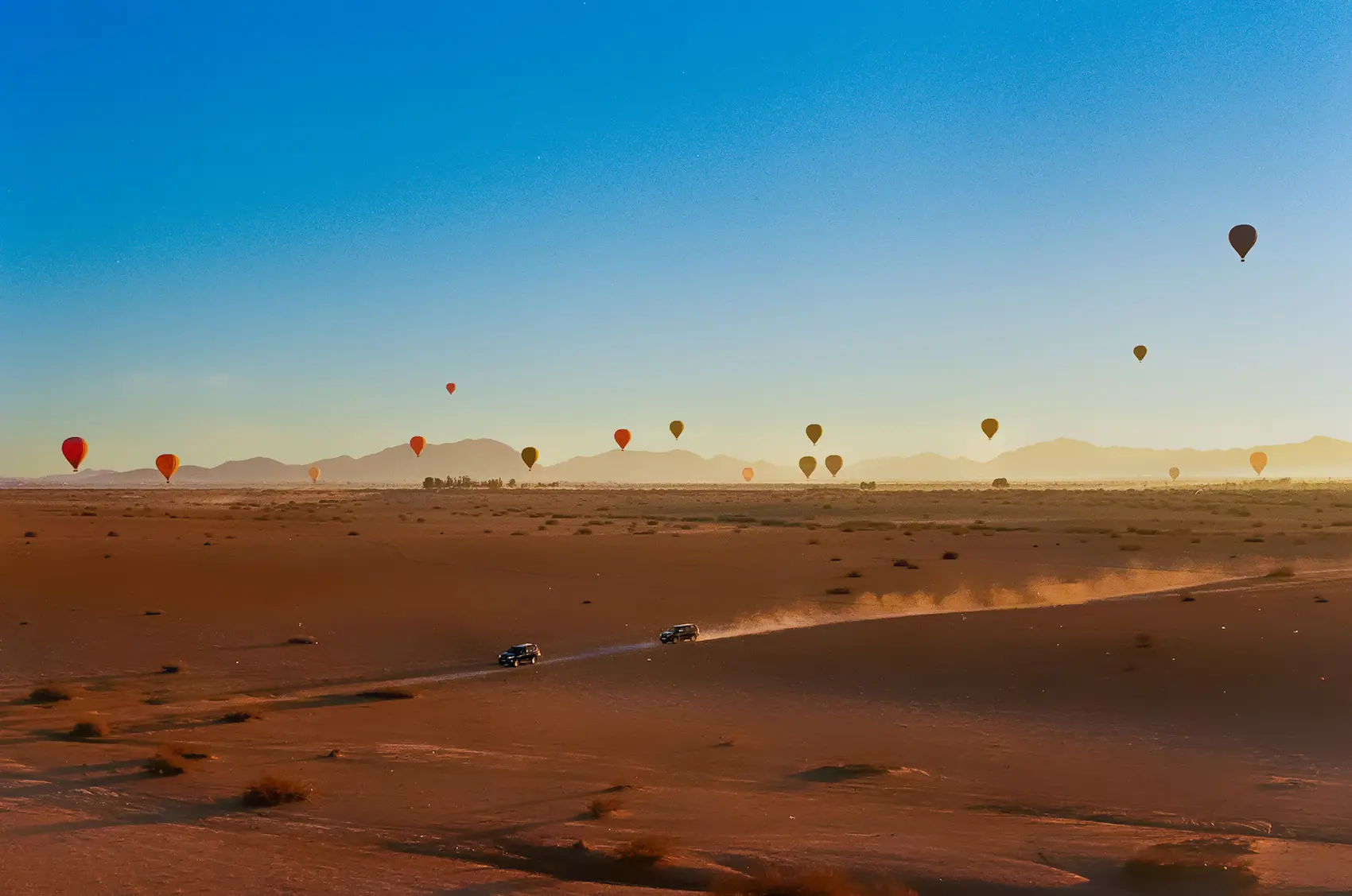
- Hot air balloon: Pickup is often before 5 am. The most weather-dependent activity on the plateau and the most expensive by a wide margin.
- Sunset dinner with music: The default evening. Tagine, Amazigh drumming, sometimes a fire show. Quality varies far more than price does.
- Pool day passes: A real activity from May to September, not filler. Several camps sell day access without an overnight stay.
- Walking the ridges: Free, unsold, and the best hour you will spend here. Twenty minutes out from camp the noise drops away entirely.
- Lalla Takerkoust: Lakeside lunch, small boats and jet skis on the reservoir, roughly 15 to 25 minutes from most camps.
- Horse riding: Offered by a handful of stables on the plateau edge. Less common than camels and usually booked direct.
Quad biking earns its top billing. On sand a quad sinks and slides; on Agafay’s packed reg it holds a line, so an hour actually covers ground and climbs ridges. It is the one activity that works better here than at Erg Chebbi.
The camel ride is the opposite case. Agafay camel rides are short loops led on foot rather than treks, because there is nowhere to trek to. Take it if you have never sat on a camel, and skip it if the dunes are still on your itinerary.
What You Cannot Do at Agafay
Sandboarding is the main one. Some operators still list it, and what you get is a short slide down one of the metre-high sand patches near the lake. Real sandboarding needs a proper dune face, which is why it belongs at Erg Chebbi.
You also cannot climb dunes, walk barefoot across soft sand, or take a multi-day camel expedition. The plateau is small enough that a half day covers it, and there is no deeper desert to walk into from here.
Nomad encounters are worth setting expectations on too. Agafay has working shepherds and small farming settlements, not the semi-nomadic families you meet around Merzouga. Any tour selling a nomad visit on the plateau is stretching the word.
Expert tip: Book quad biking in the morning slot rather than at sunset. The light is worse, but the dust has settled overnight and you are not sharing the tracks with three other convoys heading to dinner.
Agafay Desert Weather: Month by Month and Best Time to Visit
Agafay Desert weather is continental and semi-arid. Days run far hotter than nights, and the gap between the two is the single most useful number for planning.
This matters because almost everything you do in Agafay happens at the edges of the day. Camel rides, quad biking and balloon flights fill the early morning or late afternoon. Dinner, drumming and stargazing all happen after dark, in the outdoor part of the camp.
March, April, May, October and November are the comfortable months. Days are warm enough for a pool or an open jeep, and evenings need only a jacket. April and October are also the most reliable months for hot air balloon flights, which cancel for wind.
July and August are hard work between roughly noon and 5 pm. The plateau has no shade, no water and no natural cooling. Camel rides and long quad sessions in that window are genuinely unpleasant, and reputable operators schedule around them. The same logic applies further south, as our guide to the Sahara in summer explains.
December, January and February flip the problem. Afternoons can be pleasant in full sun, then the temperature drops sharply once the light goes. If your camp has no heating, the hours after midnight decide whether you sleep, and our post on visiting the desert in winter covers what to pack.
| Month | Average high | Average low | Rain or cloud note | Wind and dust note | Best for | Visitor note |
|---|---|---|---|---|---|---|
| January | About 19°C / 66°F | About 6°C / 43°F | One of the wetter months, occasional grey days | Cold night breeze off the Atlas | Atlas snow views, lunch stops | Overnight only in a heated tent |
| February | About 20°C / 68°F | About 8°C / 46°F | Some rain, clear spells between fronts | Gusty afternoons | Day trips, photography | Bring a proper coat for dinner |
| March | About 23°C / 73°F | About 10°C / 50°F | Showers possible, green scrub after rain | Windy spells, some dust | Camel rides, quad biking | Start of the comfortable season |
| April | About 26°C / 79°F | About 12°C / 54°F | Mostly dry and clear | Calm mornings, breezy evenings | Balloon flights, overnight camps | Book camps early, high demand |
| May | About 29°C / 84°F | About 14°C / 57°F | Dry, strong sun | Occasional dust haze | Pool camps, sunset dinners | Use sun cover from 1 pm |
| June | About 34°C / 93°F | About 18°C / 64°F | Dry, cloudless | Hot dry wind on some afternoons | Late sunsets, stargazing | Shift activities before 10 am |
| July | About 38°C / 100°F | About 21°C / 70°F | Dry, harsh light | Chergui heat wind possible | Night dinners, pool camps | Avoid midday camel rides |
| August | About 38°C / 100°F | About 21°C / 70°F | Dry, hazy horizons | Dust reduces Atlas visibility | After-dark experiences only | Weakest month for photography |
| September | About 33°C / 91°F | About 18°C / 64°F | Dry, rare thunderstorm | Calmer than August | Overnight camps, quad biking | Heat eases in the last week |
| October | About 28°C / 82°F | About 15°C / 59°F | Mostly dry, clearer air | Light winds | Balloon flights, all activities | Arguably the best month overall |
| November | About 23°C / 73°F | About 10°C / 50°F | First rains, sharp clear days | Cool evening breeze | Hiking the ridges, day trips | Heating starts to matter at night |
| December | About 19°C / 66°F | About 7°C / 45°F | Wetter, short daylight | Cold after sunset | Atlas snow backdrop, lunches | Confirm heating before booking |
Figures are indicative regional averages for the Marrakech and Lalla Takerkoust area. Agafay nights typically run a few degrees cooler than the city because the plateau is open and unbuilt. Check a forecast in the week before travel, especially for balloon flights.
For the deep desert further south the numbers are different again, and our Sahara desert weather guide covers Merzouga month by month. For the whole country, see our month by month Morocco guide.
Expert tip: For an overnight camp, judge the trip by the temperature after midnight rather than the afternoon high, particularly from November to March.
Agafay Desert Day Trip: What a 250 MAD Tour and an 800 MAD Tour Actually Include
An Agafay Desert day trip is sold at wildly different prices, and the gap is not agency greed. At the bottom of the market you are buying a seat. At the top you are buying the schedule.
The cheapest tickets, around 250 MAD or $25 per person, put you on a shared minibus with fifteen to twenty other people. Pickup runs on a loop around several hotels and riads, so departure can take an hour. Camel time is short, often ten to fifteen minutes, because the same animals must serve every group before sunset.
The mid tier, roughly 400 to 600 MAD or $40 to $60, usually means a private car or a small group. That changes the day more than the food does. You leave when you want, stop where you want, and you are not waiting for a straggler in the Hivernage hotel loop.
At 800 MAD and above you are paying for a private vehicle, a camp that reserves your table, a longer camel ride or quad session, and a proper dinner rather than a set plate served to a hundred people at once. Fire shows and Amazigh drumming are common at this tier, though quality varies hugely between camps.
The same shared versus private logic drives pricing on the longer Sahara routes, and our comparison of private versus group desert tours breaks down where the money actually goes.
What Most Guides Get Wrong About Cheap Agafay Tours
Most articles present the 250 MAD tour as the same trip with a smaller margin. It is not. It is a different product built around throughput.
The clearest tell is the commission stop. Many low-cost routes include a twenty to thirty minute visit to an argan cooperative or a pottery shop near Tameslouht, where the operator or driver earns a percentage of anything you buy. That time comes out of your camel ride or your sunset, not out of the driver’s day.
The second tell is return timing. Shared tours leave when the last passenger boards, which can mean sitting in a cooling tent for forty minutes after the show ends. Private transfers leave when you do.
Expert tip: Ask the operator in writing whether an argan cooperative stop is included, because a twenty minute commission stop can quietly eat your camel time or your sunset slot.
| Tier | Price band MAD | Price band USD / EUR | Transport | Camel ride | Meals and drinks | Fire show | Argan stop | Group size | Who it suits |
|---|---|---|---|---|---|---|---|---|---|
| Shared minibus tour | From about 250 | About $25 / 23 EUR | Shared minibus, multi-hotel pickup | Usually 10 to 15 minutes | Set plate or tea only, drinks extra | Sometimes, shared with all groups | Often included | 15 to 20 people | Backpackers, tight budgets |
| Private car day trip | About 400 to 600 | About $40 to $60 / 37 to 55 EUR | Private car with driver | Typically 20 to 30 minutes | Lunch or dinner usually included | Camp dependent | Skippable on request | 1 to 4 people | Couples, small groups, first timers |
| Premium private day trip with dinner or show | About 800 and above | About $80 and above / 75 EUR and above | Private car or 4×4, flexible timing | 30 minutes or more, or a quad session instead | Full dinner, reserved table, drinks often extra | Usually included | Excluded | Private | Couples, families wanting control of the evening |
| Overnight budget camp | About 250 to 600 per person | About $25 to $60 / 23 to 55 EUR | Shared transfer or own arrangement | Often a short ride included | Dinner and breakfast, drinks extra | Basic drumming or none | Varies | Shared camp | Backpackers, groups who accept noise |
| Overnight luxury camp | Commonly in the thousands per tent | From roughly $150 to $600+ / 140 to 550+ EUR | Private transfer, often arranged by camp | On request, extra | Half board typical, wine list at some camps | On request or scheduled | Excluded | Private tent | Couples, honeymooners, comfort seekers |
| Quad biking add-on | Typically a few hundred MAD per hour | Roughly $30 to $60 / 28 to 55 EUR | At the camp or activity base | Not applicable | Tea break usually included | Not applicable | Not applicable | Small group with guide | Active travellers, teenagers |
| Camel ride add-on | Typically 100 to 250 MAD | Roughly $10 to $25 / 9 to 23 EUR | At the camp | 15 to 45 minutes depending on price | Mint tea at the end is common | Not applicable | Not applicable | Small caravan | First camel experience, photographers |
| Hot air balloon add-on | Highest cost activity in the area | Typically well over $150 / 140 EUR per person | Very early hotel pickup | Not applicable | Breakfast after landing is standard | Not applicable | Not applicable | Shared basket, private baskets cost more | Special occasions, clear-weather months |
Bands reflect the market at the time of writing and move with season, fuel costs and demand. Balloon and quad prices in particular change year to year, so treat these as brackets and ask for a written itemised quote.
To place these numbers inside a full trip budget, our breakdown of what a Morocco trip costs covers daily spend by travel style.
Agafay Desert Camps: How to Choose the Best Camp for You
An Agafay Desert camp is not defined by its tents. It is defined by four things: bathroom type, climate control, what the meal plan actually covers, and where the camp sits on the plateau.
Bathroom type is the first filter. Options range from a private bathroom inside your tent, to a private bathroom in a separate structure a few metres away, to a shared block, to a dry toilet with no running water. All four exist within a fifteen minute drive of each other in Agafay.
Climate control is the second. Some camps run heating and air conditioning from a generator or the grid. Others hand you a wood brazier, thick wool blankets and a hot water bottle. In January that difference is the whole night; in August it is the difference between sleeping and lying awake.
Location decides noise and privacy. Camps clustered near the main access tracks receive day trippers, quad convoys and evening buses. Camps set behind a ridge, further toward Lalla Takerkoust or the Kik plateau side, feel genuinely quiet after 10 pm but take longer to reach and cost more to transfer to.
The last filter is the meal plan. Half board, meaning dinner and breakfast, is the norm. Full board exists at the higher tiers. Drinks are almost always extra, and alcohol policy varies from a full wine list to none at all, so ask before you plan a celebration. Our guide to desert camp food covers what usually appears on the table.
If you want the same filters applied to the deep Sahara camps, our guides to Morocco desert camps and desert camp facilities compare tiers at Erg Chebbi.
| Camp name | Tier | Location note | Bathroom type | Heating or air conditioning | Meals included | Price band, confirm at booking | Who it suits |
|---|---|---|---|---|---|---|---|
| BE Agafay | Luxury, resort style | Open plateau with Atlas views, pool and spa facilities | Private, expect ensuite in the tent or suite | Expect both, confirm by tent category | Half board typical, drinks extra | Top tier, commonly $250+ per night | Couples wanting hotel-standard comfort in the desert |
| Scarabeo Camp | Upper mid to luxury, vintage tented style | Set among stone hills, deliberately low-tech and remote feeling | Private, some tents with adjoining bathroom rather than ensuite | Stoves, heaters and blankets rather than full climate control | Dinner and breakfast usually included | Upper mid, expect roughly $150 to $350 | Photographers and travellers who want atmosphere over amenities |
| Caravan by Our Habitas | Luxury, design led | Ridge position with wide Atlas views, pool and restaurant | Private ensuite | Expect climate control in the tents | Half board common, restaurant a la carte | Top tier, commonly $250+ per night | Design-driven couples, wellness and slow evenings |
| Inara Camp | Mid to upper mid | Accessible location, pool, family friendly layout | Private ensuite in most tents | Heaters and fans, confirm for winter dates | Half board typical | Mid tier, expect roughly $100 to $250 | Families and first timers wanting comfort without luxury pricing |
| La Pause | Mid, off grid and rustic | In a valley near the Agafay edge, lanterns instead of electricity | Mix of private rustic bathrooms and shared facilities | No mains climate control, braziers and blankets | Lunch is a major draw, half board for overnight guests | Mid tier, expect roughly $80 to $200 | Travellers happy without plugs, Wi-Fi or air conditioning |
| White Camel Lodge | Mid range with pool | Standard Agafay access area, walkable ridges nearby | Private in most tents, confirm category | Fans and heaters, not full climate control | Half board typical | Mid tier, expect roughly $80 to $200 | Couples and small groups on a middle budget |
| Typical budget shared camp | Basic | Clustered near main tracks, day trip traffic until evening | Shared block or dry toilet, limited hot water | None, blankets only | Dinner and breakfast, drinks extra | Roughly 250 to 600 MAD, about $25 to $60 per person | Backpackers and groups who prioritise price over quiet |
Camp facilities, tent categories and rates change by season, and some camps close or reduce service during peak summer weeks. Confirm bathroom type, heating, meal inclusions and check-in time directly with the camp before you pay a deposit. Nothing in this table is a paid placement.
Agafay Desert Luxury Camp for Couples
For couples, the best Agafay camp is usually the one with a private bathroom inside the tent and reliable heating or cooling. BE Agafay and Caravan by Our Habitas sit in that bracket, with pools, restaurants and staffed service.
Scarabeo Camp belongs in the same conversation but plays a different game. It leans on canvas, lanterns, rugs and vintage furniture rather than on switches and thermostats. Guests who love it love the restraint; guests who wanted a resort feel short-changed.
Two questions decide a luxury booking. Is the private bathroom inside the tent or a few steps outside, and does the tent have real heating in winter? Ask both in writing, because photographs rarely show the walk.
Expert tip: For a couple booking an Agafay Desert luxury camp, ask whether the private bathroom is inside the tent or a short walk away; in December and January, an outdoor bathroom changes the whole night.
Mid-Range Camps for Comfort Seekers
The mid range is where most first-time Marrakech visitors should look. Inara Camp and White Camel Lodge sit here: private bathrooms in most tents, a pool for the hot months, half board, and prices that do not consume the rest of your trip budget.
La Pause is the outlier at this level. It runs off grid with no electricity in the rooms, so you get lantern light, deep quiet and no charging point beside the bed. For some travellers that is the point; for anyone travelling with devices, teenagers or a CPAP machine, it is a hard no.
At this tier, ask about the camp’s position relative to day-trip traffic. A mid-range camp that hosts three hundred dinner guests feels very different from one that hosts twenty.
Budget Shared Camps for Backpackers and Families
Budget camps in Agafay work if you know what you are buying. Expect a shared bathroom block or a dry toilet, cold nights with blankets rather than heating, and neighbours on the other side of a canvas wall.
They are honest value at roughly 250 to 600 MAD, about $25 to $60 per person, with dinner and breakfast. The stone plateau does not care how much you paid, and the sunrise from a budget camp is the same sunrise.
Families should check tent configuration carefully. Some camps sell a four-bed tent as private; others put two unrelated bookings in one tent. Ask whether your tent is exclusive to your party, and pack earplugs either way. Our guide on whether the desert suits kids covers the age question honestly.
Agafay Desert vs Merzouga: The Honest Verdict for Dune Seekers
If you want dunes, Agafay is not your answer. Agafay is reg and hammada, a stone desert an hour from Marrakech. Merzouga is the gateway to Erg Chebbi, a genuine sand sea with crests high enough to lose your sense of scale.
The trade is time. Agafay gives you a desert-style evening inside a three day Marrakech break, with no long drive and no early start. Merzouga costs you either a long overland route through the Draa Valley and Todra Gorge, or a domestic flight to Errachidia and a transfer. Our breakdown of the Marrakech to Sahara distance and travel time sets out what that drive really involves.
For dune seekers with three or more nights, replacing an Agafay overnight with a proper Merzouga trip is almost always the better call. Our post on how many days you need for a Sahara tour answers that by trip length. For travellers with two nights and a fixed return flight, Agafay is the sensible compromise, provided nobody in the group is expecting sand.
We compare the two side by side, including cost, night sky and time commitment, in our full Agafay Desert vs Sahara comparison.
Expert tip: Never book an Agafay camp because its listing photo shows dunes; those photos are usually taken elsewhere, and the plateau will not match them.
How to Get to Agafay Desert from Marrakech
Reaching the Agafay Desert from Marrakech is easy but not casual. The route runs southwest out of the city past Tameslouht, then onto secondary roads and unpaved tracks toward the camps and Lalla Takerkoust.
Published distances range from 25 to 40 km, because sources measure from different points in Marrakech to different camps spread across a wide plateau. Rather than trust one number, plan on 40 to 60 minutes of driving each way, and add time in the afternoon rush out of the city.
Petit taxis, the small city taxis, are licensed for urban work and do not run out to Agafay. This trips up travellers who assume they can flag one at the camp gate. They cannot, and there is nothing to flag.
Your realistic options are four. A private car with driver, arranged by an operator or your riad. A shared minibus included in a tour. A grand taxi negotiated for a round trip with waiting time. Or a rental car, which handles the tarmac fine but needs care on the final tracks after rain.
The last few kilometres to some camps are unsurfaced and rutted. A standard hatchback usually manages in dry weather at low speed. After winter rain, ask the camp whether a 4×4 is needed, because a stuck car in the dark on a track with no lighting is a long evening. If you are weighing self-drive more broadly, see our guides to driving to the Sahara desert and visiting the Sahara without a tour.
Return timing is the part people underestimate. Dinner and fire shows finish late, and drivers do not cruise the plateau looking for fares at 11 pm. Pre-book the return leg and confirm the pickup point, especially if you have booked a camp dinner independently of your transport.
Expert tip: Book the return leg before you leave Marrakech, because phone signal is patchy at some camps and there is no walk-up transport option once the tour buses have gone.
Agafay Desert Night Sky: What You Will Actually See
The Agafay Desert night sky is good. It is not a dark sky reserve, and any listing that claims zero light pollution is selling you something.
Marrakech is a city of well over a million people, sitting a short drive to the northeast. From open ground on the plateau its light dome is visible as a pale orange glow low on that horizon. Camps positioned behind a ridge screen it better than camps on flat open reg.
What Most Guides Get Wrong About the Agafay Night Sky
Most articles copy the same claim: pristine skies, zero light pollution, guaranteed Milky Way. Two things break that promise.
The first is geography, as above. The second is the moon. A full moon washes out faint structure completely, and no camp, guide or telescope changes that. Travellers who book a stargazing-focused night on a full moon are disappointed by physics, not by the camp.
What you will actually see on a clear, moonless night away from the city glow is a strong scatter of stars, obvious planets, and the Milky Way as a soft band overhead from roughly June to September. That is a genuinely good naked-eye sky. It is not Erg Chebbi, where the horizon is dark in every direction, and our guide to stargazing in the Sahara explains the difference.
Practical points help more than equipment. Give your eyes twenty minutes without looking at a phone screen. Ask the camp to dim the terrace lanterns near your table. Bring a jacket, because the best viewing window is also the coldest part of the night.
Expert tip: Ask camp staff which direction the Marrakech glow appears from their terrace, then sit with your back to it for the darkest view.
Is the Agafay Desert Worth It for First-Time Marrakech Visitors?
Yes, if you want an evening of open country, sunset light and a first camel or quad ride within an hour of your riad. No, if your mental image of Morocco’s desert is a dune ridge at dawn.
Agafay earns its slot on short trips. On a three to five day Marrakech break, it gives you a landscape day without sacrificing a full day to driving. Sunset over the Atlas from a stone ridge is a real experience, and it costs you an afternoon, not two days.
It also works for travellers who want desert atmosphere with normal comforts. A private dinner at a camp, a pool afternoon on the plateau, or one night in a heated tent with a proper bathroom suits people who would not enjoy an eight hour drive and a shared Sahara camp. If you are weighing the longer trip, our post on whether a Sahara desert tour is worth it answers that without the sales pitch.
Skip it if you are already going to Merzouga or Zagora. Two stone desert evenings before a real erg trip add nothing except cost and a rushed afternoon. Skip it too if your group includes someone who cannot cope with unpaved access roads or shared facilities at the budget end.
The overnight versus day trip question comes down to one thing: what happens at 10 pm. Day visitors leave, generators quieten, and the plateau goes silent in a way no daytime visit reveals. If that appeals more than the fire show does, book the night.
Whichever you choose, layers matter more than anything else you carry, and our Sahara packing list covers the night-time gear most visitors underestimate.
Expert tip: If your only free evening is the first night after a late flight, move Agafay later in the trip, because transfers can run past midnight and jet lag plus a cold tent is a bad combination.
Ready to Choose Between an Agafay Sunset and a True Sahara Night?
Agafay is a real stone desert, close to Marrakech and genuinely quiet after dark, but it is not a sand dune Sahara and no camp can make it one. The right choice depends on whether you want a short escape from the medina, one comfortable night under canvas, or the tall dunes of Erg Chebbi. Book for your travel style, not for the lowest headline price, and confirm bathroom, heating and return transport in writing before you pay.
The next question worth asking is what a Merzouga night actually costs in time and money compared with an Agafay evening.
We plan private evenings in the Agafay Desert from Marrakech. You get a driver who knows the tracks, a camp matched to how you actually like to sleep, and a return time you set rather than the last passenger on a minibus.
We also run Merzouga and Erg Chebbi Sahara tours for travellers who want the dunes as well: a 3-day Marrakech desert tour, a 3-day Fes desert tour, or a longer route from our full tour list.
Tell us your dates and we will tell you honestly whether Agafay fits your trip or whether you should hold out for the dunes.
Contact us: contact@mementomorocco.com | +49 1522 3075977 | WhatsApp