Sahara Desert Stargazing: Night Sky Guide for Merzouga
Merzouga has some of the darkest skies in Morocco, but simply sleeping in the Sahara does not guarantee a great night of stargazing. The moon, season, camp location, artificial light, and even the time you step outside can make a noticeable difference.
If you want to see the Milky Way clearly, choosing the right night matters more than most travel guides suggest. A full moon can wash out faint stars, while a moonless night can completely change what you see above the dunes.
This guide explains when to go, where to stay, what conditions to look for, and how to photograph the night sky in Merzouga. You’ll also learn what to expect after sunset, how long your eyes need to adjust, and how to choose a desert camp that won’t ruin the experience with unnecessary light.
Quick Facts
- Dark sky rating: Bortle Class 1 to 2 at Merzouga. Most of Europe never gets darker than Class 4.
- Location advantage: Roughly 800 m elevation and more than 470 km from the nearest major city light source.
- Why the skies stay clear: Near-zero humidity, no light scattering, and no urban heat-island effect over the dunes.
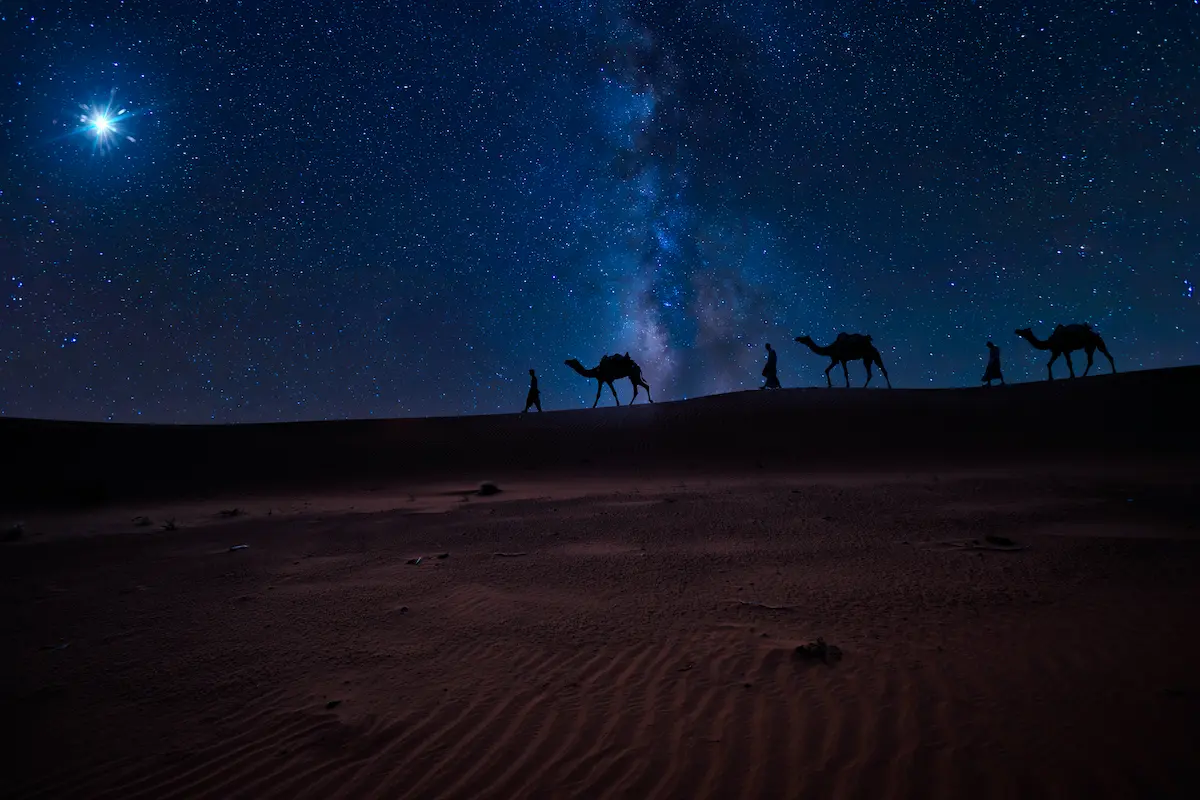
- Milky Way core season: Late March through early October. Peak visibility in June and July, highest between midnight and 3 AM.
- Best overall months: April, May, September, October. Comfortable nights (12 to 22°C) and lowest atmospheric dust.
- Winter limitation: The Milky Way core is not visible from November through February. You get Orion and winter constellations instead.
- New moon: Darkest skies, maximum star count, visible zodiacal light.
- Crescent moon (10 to 30%): Soft dune light for photography without washing out the stars.
- Full moon: Faint stars disappear and the Milky Way becomes nearly invisible, but the dunes turn silver.
- Best nightly window: Starts about 90 minutes after sunset when astronomical twilight ends.
- Best pre-dawn window: 4 AM to sunrise, when the atmosphere is at its most transparent.
- Eye adaptation: Allow 20 minutes without white light for full night vision.
- Temperature swing: Up to 20°C (36°F) between afternoon and 3 AM. Dress in thermal base, fleece, insulated jacket, hat, gloves.
- Camera settings: ISO 1600 to 3200, aperture f/2.8 or faster, shutter speed using the 500 Rule (20 mm lens = 25 seconds).
- Battery warning: Lithium-ion loses 30 to 50% capacity below 10°C. Carry at least three batteries and keep spares against your body.
- Question to ask your camp: “Do you switch off all non-essential lights after dinner?” A true dark-sky camp will have a lights-out protocol after 10 or 11 PM.
- Camp placement tip: Request a tent on the camp perimeter, facing away from the dining and fire area. Deeper into Erg Chebbi means darker skies.
- Acoustic bonus: No insects, no traffic, no electrical hum. The silence amplifies the visual experience.
Light pollution figures based on the Bortle Dark Sky Scale. Milky Way visibility depends on season, moon phase, and camp location.
Why Merzouga is a Unique Dark Sky Sanctuary
Merzouga sits at roughly 800 meters elevation in the southeastern corner of Morocco, more than 470 kilometers from the nearest significant light source (Fes or Marrakech). This isolation is biological, but the exceptional stargazing comes from physics. The hyper-arid climate of the Erg Chebbi region means water vapor in the atmosphere hovers near zero most nights, eliminating the light scattering that dulls stars in more humid deserts. The sand sea itself creates a stable thermal environment with minimal heat-island effect, so the air column above you remains undisturbed.
On the Bortle Dark Sky Scale, which measures light pollution from Class 1 (pristine) to Class 9 (inner city), Merzouga rates as a Class 1 or Class 2 site depending on moon phase and camp location. For context, most of Europe never gets darker than Class 4. At Class 1, the Milky Way casts visible shadows, the zodiacal light (a cone of interplanetary dust reflecting sunlight) becomes apparent, and you see stars so faint they have no names. Erg Chebbi, the iconic dunes of Merzouga, offers this natural advantage simply by existing where it does.
The clearest skies, contrary to expectation, occur not in the scorching summer months but in the shoulder seasons of April to May and September to October. During deep summer, the Chergui (a hot, dust-laden wind from the Sahara interior) can carry fine particulates that slightly diffuse starlight. In the cooler months, the atmosphere stabilizes, and the dust settles. This is not an opinion. This is observable, predictable atmospheric behavior that separates an excellent stargazing night from a transcendent one.
The Best Time for Stargazing in the Moroccan Sahara
The Milky Way’s galactic core, the dense, dramatic band most people want to photograph, is visible from late March through early October in the Northern Hemisphere. Peak visibility occurs from June through July when the core sits highest above the southern horizon between midnight and 3 AM. But visibility alone does not determine the best time for stargazing Morocco. You must balance celestial events with weather comfort and sky clarity.
April, May, September, and October deliver the ideal combination: the Milky Way core is visible for at least part of the night, temperatures range from 12°C to 22°C after dark (comfortable for sitting outside), and atmospheric dust is at its annual low. June and July offer the most spectacular galactic core views but come with daytime heat exceeding 40°C and slightly hazier skies. November through February feature longer nights and winter constellations like Orion in full glory, but the Milky Way core sets too early to observe. Choose based on what you want to see: galactic core or winter sky clarity.
Moon phase matters more than most travelers realize. A new moon (0% illumination) provides the darkest skies and maximum star count. A crescent moon (10% to 30% illumination) adds soft foreground light to illuminate the dunes for photography without washing out the stars. A full moon obliterates faint stars and turns the Milky Way nearly invisible, but it transforms the dunes into a silver dreamscape worth experiencing in its own right. Plan your trip around the lunar calendar if stars are your priority. The best nightly window runs from 90 minutes after sunset, when astronomical twilight ends, until moonrise if the moon is waxing. Our detailed month-by-month guide to Moroccan weather breaks this down further with temperature ranges and crowd levels.
Check the lunar calendar for Merzouga at timeanddate.com before booking.
What Most Guides Get Wrong About Sahara Desert Stargazing Seasons
Most travel articles recommend winter for Sahara stargazing because the nights are long and the air is cold. This advice is half-correct and misleading. Yes, winter nights in Merzouga are crystal-clear and can drop below freezing, offering superb visibility for winter constellations. But the Milky Way’s galactic core, the feature that defines a “bucket list” stargazing experience, is not visible from November through February in the Northern Hemisphere. You will see stars, certainly thousands of them, but not the dramatic river of light that appears in promotional images. If your goal is to photograph or witness the iconic Milky Way, winter is the wrong season. April through October is non-negotiable. This is not subjective. This is orbital mechanics.
Choosing Your Desert Camp: Minimizing Light Pollution
Not all desert camps respect the darkness. Many luxury properties install permanent LED pathway lighting, decorative lanterns, and illuminated common areas that operate all night for safety and ambiance. These lights can reduce a Class 1 sky to a Class 3 or Class 4 experience, especially if your tent sits within 50 meters of the source. The camp’s lighting policy matters as much as its distance from Merzouga village (5 km into the dunes vs. 15 km makes a measurable difference).
When booking, ask this exact question: “Do you switch off all non-essential lights after dinner for stargazing?” A camp committed to dark skies will have a lights-out protocol after 10 PM or 11 PM. Compare different types of Sahara desert camps and prioritize those located deeper into the Erg Chebbi dune field, away from the paved road and village glow. Standard Berber camps with minimal generator use often provide darker conditions than glamping sites with solar-powered LED arrays that remain on indefinitely.
Request a tent on the camp’s perimeter, facing away from the central dining or fire area. Even a 30-meter separation from a light source can double the number of visible stars. If you are booking a private tour, specify your stargazing priority upfront. Guides who understand this will select camps based on sky quality, not just amenities. The most authentic dark sky experience comes from simplicity: a traditional camp with wool blankets, mint tea, and kerosene lamps that get extinguished when you step outside.
Astrophotography Tips for the Sahara Desert
Photographing the Milky Way in Merzouga requires preparation for three environmental factors: extreme temperature swings, fine sand infiltration, and the absence of artificial foreground light. Your gear must handle these conditions without compromising image quality. Start with a sturdy tripod (use sandbags or bury the legs 5 cm into the sand for stability), a wide-angle lens with an aperture of f/2.8 or faster, a remote shutter release or 2-second timer, and a headlamp with red light mode to preserve your night vision.
Set your camera to full manual mode. Begin with ISO 1600 to 3200, aperture wide open at f/2.8, and a shutter speed calculated using the 500 Rule: divide 500 by your focal length in millimeters. For a 20mm lens, that gives you 25 seconds before star trailing becomes visible. Focus manually on the brightest star, then lock focus and do not touch the lens again. Take a test shot, review the histogram (not the LCD screen, which lies in darkness), and adjust ISO or shutter speed as needed. Essential items for your Sahara adventure include lens wipes and a microfiber cloth; sand will coat your gear within an hour.
Protect your equipment between shots. Use a large ziplock bag or a dry sack as a makeshift dust cover when swapping lenses or batteries. Let your camera acclimate to temperature changes slowly; moving from a 25°C tent interior to a 5°C exterior in seconds can cause condensation on the sensor. For composition, place a tent, a person wrapped in a blanket, or a single tree in the foreground as a silhouette. The dunes alone create leading lines, but a human element adds scale and story. Shoot during blue hour (20 minutes after sunset) to capture the dunes with residual light before the stars fully emerge.
Battery Management in Cold Desert Nights
Camera batteries lose 30% to 50% of their capacity when temperatures drop below 10°C, which happens routinely in Merzouga from October through April. Carry at least three fully charged batteries. Keep spares in an interior jacket pocket against your body heat between shots. A battery that reads dead in the cold will often revive when warmed. This is not a quirk. This is lithium-ion chemistry responding to temperature. Photographers who ignore this lose half their shooting window to dead batteries.
Beyond the Stars: The Full Nocturnal Experience
The temperature in Merzouga can swing 20°C or 36°F between afternoon and 3 AM. A day that peaks at 30°C in April will drop to 10°C by midnight. In January, expect nighttime lows near freezing even if the afternoon felt warm. Dress in layers: thermal base, fleece mid-layer, insulated jacket, wool hat, and gloves. The cold is dry and penetrating, not damp. It seeps in slowly, and by the time you notice, you have been shivering for ten minutes.
The silence is the second revelation. The Sahara at night produces almost no sound. No insects, no distant traffic, no electrical hum. You hear your own breath. You hear the fabric of your jacket when you shift position. Occasionally, a desert fox barks in the distance or the wind hisses over the crest of a dune. This acoustic void amplifies the visual experience. The stars feel louder because nothing competes for your attention. Some Amazigh guides offer brief night walks to explain traditional Berber navigation by stars, identifying Polaris and the summer triangle the way their grandparents did before compasses.
The absolute best stargazing occurs between 4 AM and sunrise. Most tourists are asleep. The camp is silent. The air has cooled to its maximum density, and the atmosphere is at its most transparent. The Milky Way arcs from horizon to horizon. If you wake before dawn, step outside. Let your eyes adjust for 20 minutes without using white light. The Milky Way will transform from a hazy cloud into a structured, three-dimensional river with dark lanes, bright clusters, and faint nebulae visible to the naked eye. This is the moment most people miss because they stay warm in their tent. What to expect on a Sahara camel trekking excursion includes sunrise over the dunes, but the pre-dawn starscape is equally worth the early wake-up.
Plan Your Sahara Stargazing Trip
Merzouga delivers world-class dark skies and straightforwardlogistics — no expedition required. Three things determine whether you see the Milky Way clearly: timing your trip to the
lunar calendar, choosing a camp that switches off its lightsafter dinner, and arriving in the right season. Everything else we handle.
Most travelers reach Merzouga from Fez or Marrakech. Bothroutes pass through some of Morocco’s most dramatic landscapes and work well as part of a longer circuit.
Choose your starting point and we will build the route around optimal stargazing conditions:
3-Day Desert Tour from Fez — the most direct route to Erg Chebbi from the north.
5-Day Fez to Marrakech Desert Tour — crosses the Atlas, Dades Gorge, and Sahara in one route.
3-Day Desert Tour from Marrakech — fastest Sahara access from the south.
10-Day Morocco Tour — Marrakech, Atlas, Sahara, and Fez. Two nights in the desert gives you the best chance of catching a moonless sky.
14-Day Grand Morocco Loop — the complete circuit. Desert camp included with timing coordinated to your travel dates and lunar calendar.
Tell us your travel dates and we will check the moon phase and confirm the best camp for your night in the dunes.