Erg Chebbi: The Complete Guide to Morocco’s Iconic Sahara Dune
Erg Chebbi is the Sahara most travelers picture when they imagine Morocco, but choosing it over Erg Chigaga isn’t always the obvious decision. The two desert regions offer very different experiences, and the difference matters if you have limited time.
Erg Chebbi, near Merzouga, is easier to reach, has far more tourist infrastructure, and works particularly well for first-time visitors. Erg Chigaga is more remote, harder to reach, and better suited to travelers looking for solitude.
So which desert is right for you, when should you visit, and what should you actually expect once you arrive?
This guide breaks down Erg Chebbi’s location, dunes, seasons, accessibility, camps, activities, and the practical differences between Chebbi and Chigaga, so you can decide whether Erg Chebbi deserves a place in your Morocco itinerary.
Quick Facts
- Location: Near Merzouga, 560 km (9–10 hours) from Marrakech; 470 km (7–8 hours) from Fes
- Dune size: Up to 150 m (490 ft) high, 28 km long, 5–7 km wide
- Sand colour: Salmon-pink and golden-orange, shifting from pale gold at noon to deep crimson at sunset
- Best seasons: March–May and September–November (20–30°C days, cool nights)
- Winter nights: Near freezing (2–8°C); bring a down jacket, hat, gloves, and warm layers
- Summer days: 38–50°C; activities shift to early morning and late evening; luxury camps with AC are essential
- Camel trek: 45–90 minutes each way, usually at sunset and sunrise; included in most tours
- Desert camp prices: Budget 400–1,000 MAD ($40–$100), Mid-range 1,000–2,000 MAD ($100–$200), Luxury 2,000–4,000 MAD ($200–$400) per person per night
- 3-day tour cost: Budget 1,800–2,200 MAD ($180–$220), Mid-range 2,200–3,000 MAD ($220–$300), Luxury 3,000–4,500 MAD ($300–$450) per person
- Number of camps: Over 200, ranging from basic Amazigh tents to luxury camps with en-suite bathrooms and pools
- Phone signal: Zero inside the dunes; bring a power bank for charging
- Sandboarding: 50–100 MAD ($5–$10), often included in mid-range or luxury tours
- Quad biking: 250–400 MAD ($25–$40) for 30–60 minutes
- Key activities beyond camels: Sandboarding, 4×4 dune bashing, quad biking, Khamlia Gnawa music village, Rissani market, Dayet Srij flamingo lake
- Wildlife concern: Scorpions exist but are not a serious risk; shake shoes out in the morning and wear closed shoes at night
- Getting there: Multi-day tour (easiest), self-drive (most flexible), public bus (cheapest), or fly to Errachidia (fastest)
All prices in Moroccan Dirham (MAD) with approximate USD equivalents. Seasonal rates vary; book 2–3 months ahead for spring and autumn.
What Exactly Is Erg Chebbi?
More than 95 percent of the Sahara is rocky desert: gravel plains, stone plateaus, and hard-packed earth. The image of endless sand dunes is the minority, not the rule.
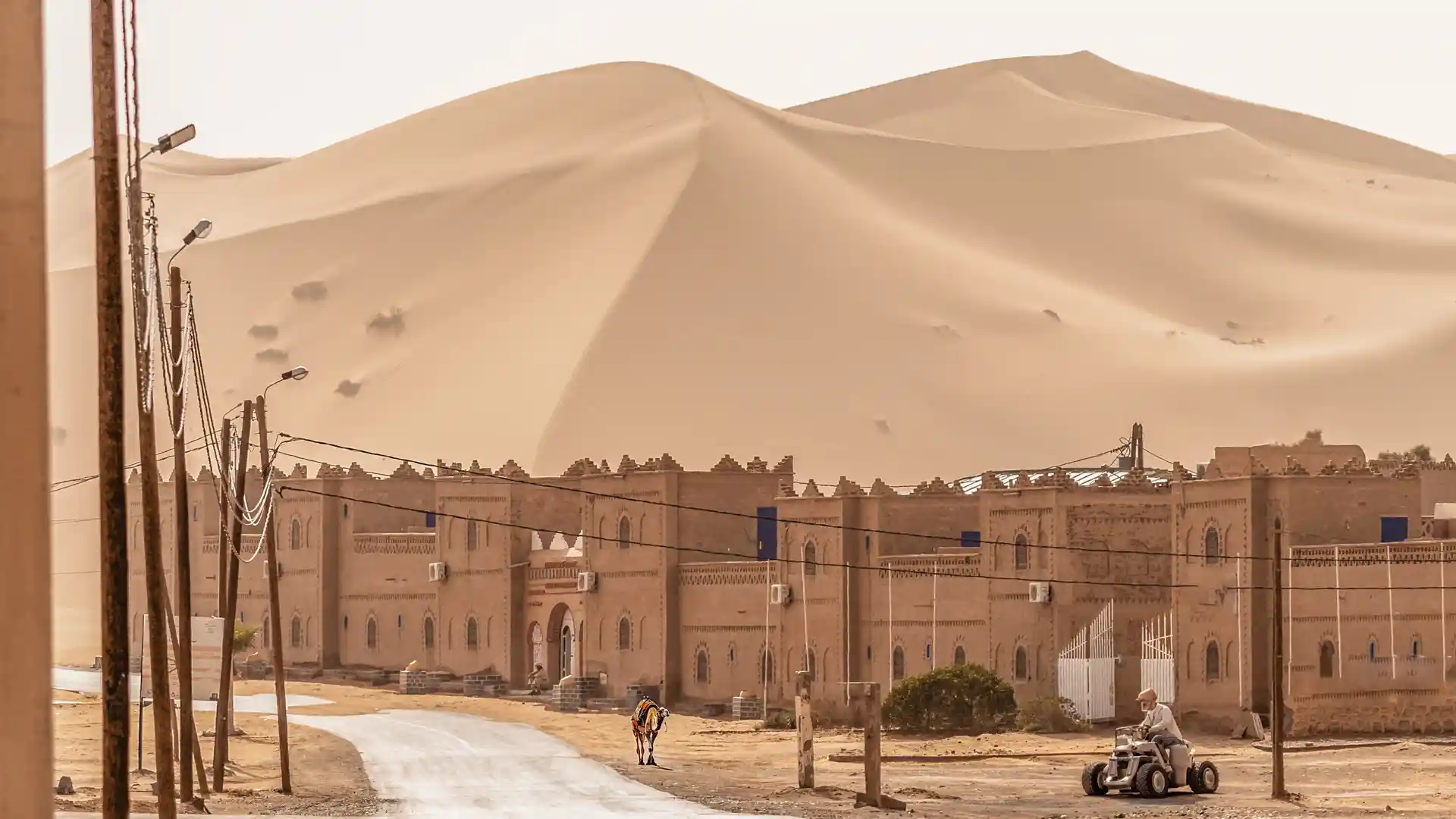
Erg Chebbi is that minority. It is one of Morocco’s two major ergs, or sand seas, a concentrated field of dunes rising from the flat desert plain near the Algerian border. These are not gentle hills.
The dunes reach up to 150 meters (nearly 500 feet) high. They stretch 28 kilometers (17 miles) in length and 5 to 7 kilometers (3 to 5 miles) wide.
The sand is salmon-pink and golden-orange, and it changes through the day. You see pale gold at noon and deep crimson at sunset. The contrast against the stark desert floor makes Erg Chebbi one of the most photogenic places on earth.
Gateway town: Merzouga. This small settlement sits on the western edge of the dunes. It is the launch point for virtually every desert experience.
Why “Erg”? In geography, an erg (from the Arabic ‘arq) is a vast area of shifting sand dunes. Erg Chebbi is Morocco’s most famous, and for good reason.
Erg Chebbi vs. Erg Chigaga: Which One Is Right For You?
This is the single most common question travelers ask. Here is the direct breakdown.
| Feature | Erg Chebbi | Erg Chigaga |
|---|---|---|
| Location | Near Merzouga, 9 hours from Marrakech | Near M’Hamid, 10-12 hours from Marrakech |
| Accessibility | Paved road straight to the dunes | Last 60km require 4×4 off-road |
| Dune Height | Up to 150m (490ft) | Up to 160-200m (525-650ft) |
| Number of Camps | 200+ | 20-30 |
| Crowds | Busy, especially at sunset | Quiet, often solitary |
| Tourist Infrastructure | High – hotels, shops, restaurants | Minimal – just the camps |
| Best For | First-timers, photographers, families | Adventurers, solitude-seekers, second visits |
The Honest Verdict
Erg Chebbi is the right choice for most first-time visitors. It is easier to reach and offers far more accommodation options at every price point. You will not spend half your trip bouncing across desert tracks.
Erg Chigaga wins for solitude. Choose it if you have already seen Chebbi, have extra days, or want to feel genuinely remote. The drive is longer and rougher, and camp options are fewer. Our complete guide to Erg Chigaga covers that route in detail.
Can you do both? Not realistically. Each one needs 3 days minimum from Marrakech. Visiting both would eat most of a week-long trip.
When to Visit: Timing Is Everything
Most guides give broad seasonal advice without month-by-month specifics. Here is what you actually need.
Best Seasons: Spring and Autumn (March-May, September-November)
Daytime temperatures sit between 20°C and 30°C (68-86°F). Nights are cool but not freezing, and skies stay clear. This is peak season, so book camps 2 to 3 months in advance.
Winter (December-February)
Days are mild at 15-20°C (59-68°F), but nights drop close to freezing. Down jackets, beanies, gloves, and hand warmers are essential. The trade-off is fewer tourists and cheaper prices.
Summer (June-August)
Daytime temperatures regularly pass 40°C (104°F) and can hit 50°C (122°F). Most tours still run, but activities shift to early morning and late evening. Midday is spent resting.
If you must visit in summer, choose a luxury camp with air conditioning. Basic camps offer no relief from the heat.
Month-by-Month Quick Reference
- Mar-May: 22-30°C (72-86°F) days, 8-15°C (46-59°F) nights. Peak crowds. Ideal.
- Jun-Aug: 38-50°C (100-122°F) days, 22-28°C (72-82°F) nights. Low crowds. Avoid if possible.
- Sep-Nov: 24-30°C (75-86°F) days, 10-18°C (50-64°F) nights. Peak crowds. Ideal.
- Dec-Feb: 15-20°C (59-68°F) days, 2-8°C (36-46°F) nights. Low crowds. Good with warm gear.
Ramadan note: Dates shift annually. Tours operate normally, but guides may be fasting. Meal times adjust, and some restaurants close during daylight hours.
For a Sahar Desert temperature & weather guide, check our detailed blog article about Sahara weather for a month-by-month temperature breakdown and what to expect.
How to Get to Erg Chebbi
Most travelers start from Marrakech or Fes. Here are your options, ranked by ease.
1. Book a Multi-Day Desert Tour (Easiest)
This is what 90 percent of first-timers do, for good reason. A 3-day tour from Marrakech or Fes includes transport, guide, meals, camel trek, and camp stay. You do not have to plan anything.
Before you book, decide whether you want your own vehicle or a shared minibus. Our breakdown of private versus group Sahara tours compares cost, pace, and flexibility.
Travel time from Marrakech: 9-10 hours driving. Tours split this over two days with stops at Aït Benhaddou, Todra Gorge, and Dades Valley.
Travel time from Fes: 7-8 hours.
Cost: €200-300 per person for a 3-day tour.
2. Drive Yourself (Most Flexible)
Renting a car gives you freedom, but it comes with responsibility. The roads are well-paved all the way to Merzouga. A small hire car is fine; you do not need a 4×4 until you enter the dunes.
From Marrakech: 560km, 9-10 hours. Route N9 over the Tizi n’Tichka pass, which is high and winding.
From Fes: 470km, 7-8 hours. The route runs through Ifrane and the Middle Atlas cedar forests, scenic and less trafficked.
Parking: Leave your car at your hotel or auberge in Merzouga. They are secure.
You can read our article about the distance between Marrakech and Sahara desert for more infos, tips, and travel time.
3. Public Bus (Cheapest, Least Convenient)
Supratours runs buses from Marrakech and Fes directly to Merzouga. The ride is long, but it is possible.
Pro tip: Even if you take a bus, you still need to arrange a camp and camel trek separately. For most travelers, the tour package is simpler.
4. Fly to Errachidia (Fastest but Pricey)
Errachidia Airport (ERH) is the closest, about 2 hours from Merzouga by road. Flights from Casablanca are available but limited. You will still need ground transport from the airport.
Where to Stay: Camps, Riads, and What You Will Actually Get
Erg Chebbi has over 200 camps, ranging from basic to borderline-luxurious. Here is what each tier actually means on the ground. Our guide to Morocco desert camps goes deeper on individual properties.
Standard/Budget Camps (400-1,000 MAD / $40-100 per person)
These are traditional Amazigh tents: camel hair or wool over wooden poles, with mattresses on rugs over the sand. Bathrooms are shared, with western or squat toilets and cold water only.
Lighting comes from candles or a single battery lantern. There is no electricity in the tent, though the communal area may have a charging station.
Who it is for: Budget travelers, adventurers, and people who accept rustic conditions for one night.
The real experience: You eat family-style tagine at a communal table, then drum around the fire. You sleep under wool blankets. It is authentic and social, but not comfortable.
Mid-Range Camps (1,000-2,000 MAD / $100-200 per person)
You get private or semi-private bathrooms with running water. Some tents have electricity for a few hours in the evening. Beds, food, and service are all a step up.
Who it is for: Most travelers. This is the sweet spot of value and comfort.
Luxury Camps (2,000-4,000 MAD / $200-400 per person)
You get proper beds with frames, quality linens, and en-suite bathrooms with hot showers. Electricity runs throughout, and some camps add private terraces, gourmet meals, or WiFi. A few have pools or air conditioning.
Who it is for: Honeymooners, families with young kids, and anyone who wants the view without the rough edges.
Riads in Merzouga (Hotels on the edge of the dunes)
Many travelers spend one night in a Merzouga hotel before or after their camp stay. These range from basic guesthouses to comfortable riads with pools. It is useful if you want a proper shower after the desert.
Important distinction: “Luxury” in the desert is not Four Seasons luxury. Generators run at night and water pressure varies. You are still in the Sahara.
You can read our article for a detailed comparison between standard & luxury Sahar desert camps.
The Classic Desert Experience: What Actually Happens
Most guides romanticize this. Here is what actually happens on a typical Erg Chebbi overnight.
Day 1: Arrival and Sunset
You arrive at your hotel or auberge in Merzouga by mid-afternoon, around 3 to 4 PM. Leave your main luggage in a secure room. You will pack a small overnight bag for the desert.
Around 4:30 to 5:00 PM, you meet your camel guide. The camels kneel, less gracefully than it looks, and the caravan sets off toward the dunes.
The camel ride: 45 to 90 minutes of swaying movement across soft sand. It is not comfortable, and your hips will complain. Wear long pants and closed shoes, and read our guide to Sahara camel trekking before you go.
You reach camp as the sun drops low. The light turns the dunes from gold to amber to deep crimson. Photographs do not capture it.
Evening routine: Dinner is chicken or lamb tagine, couscous, and salad, followed by Amazigh music around the campfire. Expect drums, hand claps, and call-and-response songs in Tamazight. Our guide to Sahara desert camp food explains what gets served and how dietary requests are handled.
Stargazing: After the fire dies down, the Milky Way arcs overhead with real clarity. There is no light pollution for a hundred kilometres in any direction. See our guide to stargazing in the Sahara for the best months and moon phases.
Sleep: Tents are basic and can feel stuffy in warmer months. In winter they are cold, and you will need every blanket provided. Bring a headlamp, because pathways are dark.
Day 2: Sunrise and Return
Wake-up is early, often before 5 AM. Sunrise from a nearby dune crest is the highlight of the whole trip. Sand shifts from violet to rose to gold as the sun breaks the horizon.
Breakfast is bread, jam, cheese, and mint tea back at camp. Then you either ride the camels back or take a 4×4 transfer to Merzouga.
Total time in the desert: About 16 hours. It is not a long experience, but it is intense.
What Most Guides Do Not Tell You
- Cold nights: Temperatures drop fast after sunset. Even in April, nights can fall to 5°C (41°F). In winter, near freezing.
- Limited facilities: Basic camps have shared toilets and cold showers. Luxury camps have private bathrooms, but water pressure varies.
- No phone signal: Zero. Bring a power bank if you need to charge devices, because electricity is limited.
- Sand gets everywhere: In your shoes, your clothes, your camera, your ears. Accept it early.
- The camel ride is short: Most treks run 45 to 90 minutes each way, enough for the experience but not an expedition.
Beyond the Camel: Other Activities in Erg Chebbi
- Sandboarding: Snowboarding on sand dunes. Most camps provide boards. Cost: 50-100 MAD ($5-10). See our guide to sandboarding in the Sahara.
- 4×4 Dune Bashing: Off-road driving through the dunes with experienced drivers. Cost: 200-400 MAD ($20-40) per hour.
- Quad Biking (ATV): Ride the dunes on a quad. Cost: 250-400 MAD ($25-40) for 30-60 minutes. Read more about quad biking in the Sahara.
- Kohl Mines Visit: See the mines where locals extract traditional eyeliner. Often included in cultural tours.
- Oasis of Safsaf: A quiet palm oasis with vegetation and birdlife. Often included in longer tours.
- Visit Khamlia (Gnawa Village): Hear spiritual Gnawa music in the village of Khamlia. A donation of 50-100 MAD ($5-10) is appreciated.
Quad biking tip: Riding an ATV up and down massive dunes is genuinely fun. It is also loud, and it adds noise to a quiet landscape. Choose a responsible operator.
What to Pack: The No-Nonsense List
Most packing guides are too long or too vague. Here is exactly what you need. For the full version, see our complete Sahara desert packing list.
Essential Gear
- Headlamp or flashlight: Camps are dark at night. Essential for bathroom trips.
- Power bank: Charging is limited, often just a few evening hours.
- Headscarf or shemagh: Protects against sun, wind, and sand. Many tours sell them.
- Closed-toe shoes: Camel riding in sandals equals regret. Sturdy sneakers work.
- Warm layer (fleece or down jacket): Nights are cold year-round. Do not underestimate this.
- Sunscreen (SPF 50+): The desert sun is intense.
- Polarized sunglasses: Reduces glare off the bright sand.
- Lip balm with SPF: Lips crack quickly in dry desert air.
- Wet wipes: Showers are limited; these are a lifesaver.
- Small daypack: For your overnight essentials. Leave main luggage at the auberge.
Clothing
- Long pants (camel riding chafes bare legs)
- Lightweight long sleeves (sun protection)
- Warm hat and gloves (winter only)
- Sandals or flip-flops (for walking around camp)
What Not to Bring
- Heavy hiking boots (sand gets in them, and they are overkill)
- Expensive jewelry (it will get sandblasted)
- Hard-sided luggage to camp (leave it at the auberge)
- Expectations of luxury (even luxury camps are still camps)
Special note on scorpions: Yes, they exist. No, they are not likely to bother you. Wear closed shoes at night if you walk outside camp, and shake out your shoes in the morning.
This is basic desert common sense, not a reason to panic. Our guide to bugs, snakes, and scorpions in the Moroccan desert covers what actually lives out there.
For more planning detail, read our article on how to plan your Sahara desert trip from Marrakech, and our complete Sahara desert tour guide.
Cultural Etiquette and Practical Tips
Interacting with Amazigh Hosts
The desert camps are run by local Amazigh families. Here is how to show respect.
- Do accept mint tea when offered. It is a sign of hospitality.
- Do learn a few words of Tamazight: Azul (hello), Tanmirt (thank you).
- Do ask permission before photographing people, especially elders.
- Don’t give money directly to children, because it encourages begging.
- Don’t expect nomadic families to perform for you. They are living their lives.
Tipping
Tips are not actively solicited, but they are appreciated. Standard amounts are below.
- Camel guide: 20-50 MAD ($2-5)
- Driver/guide for multi-day tour: 50-100 MAD ($5-10) per day
- Camp staff: 20-50 MAD ($2-5) total
Health and Safety
- Getting lost in the dunes: A real risk. Stay with your guide, because dunes shift and there are no fixed landmarks.
- Dehydration: Bring water. Camps provide it, but extra is smart in summer.
- Sun exposure: Serious. Cover up, use sunscreen, wear sunglasses.
- Cold exposure: Underestimated. Nights are genuinely cold.
- Altitude sickness: Not an issue. Merzouga sits at low elevation.
Solo Female Travelers
Erg Chebbi is generally safe for solo women. Luxury camps offer more privacy through enclosed tents and private bathrooms. Standard camps put you in a shared environment, which some solo travelers find socially more secure.
Reputable operators have respectful staff. Book through a trusted agency rather than arranging a camp on arrival.
Beyond the Dunes: What Else to See Near Erg Chebbi
Most guides ignore the surrounding area. Here is what you are missing.
Rissani Market (40km from Merzouga): A historic trading town and the commercial hub of the region. Go on a Tuesday, Thursday, or Sunday for the market, where locals trade animals, spices, dates, and handicrafts. This is real Morocco, not a tourist show.
Khamlia and Gnawa Music: Khamlia is a Gnawa village, settled by descendants of people brought north through the trans-Saharan trade. Their music is spiritual, rhythmic, and powerful. A private house concert is one of the most culturally rewarding stops near Erg Chebbi, and donations of 50-100 MAD ($5-10) per person are appropriate.
Merzouga Lake (Dayet Srji): A seasonal lake that forms after rain and attracts flamingos and other migratory birds. The contrast between water and dunes is striking. It is not always full, so check conditions before driving out.
Fossil Fields near Erfoud: The area around Erfoud, about an hour from Merzouga, is known for Devonian-period trilobites and ammonites. You can visit workshops where fossils are polished into tiles and tabletops. It is fascinating if you like geology, touristy if you do not.
Sample Itineraries
3-Day Desert Tour from Marrakech (Classic)
Day 1: Marrakech to Aït Benhaddou to Dades Valley (overnight in hotel)
Day 2: Dades Valley to Todra Gorge to Merzouga to Camel trek to Desert camp
Day 3: Sunrise to Return to Merzouga to Drive back to Marrakech
Best for: First-timers with limited time. This covers the highlights efficiently. You can find more details about a 3-day tour from Marrakech to Sahara desert here.
4-Day Marrakech to Erg Chebbi (More Relaxed)
Day 1: Marrakech to Aït Benhaddou to Ouarzazate to Dades Valley
Day 2: Dades Valley to Todra Gorge to Merzouga (arrive early afternoon) to Camel trek to Camp
Day 3: Sunrise to Optional activities (4×4, sandboarding, Khamlia) to Second night in camp or hotel in Merzouga
Day 4: Return to Marrakech
Best for: Travelers who want more desert time and a less rushed pace.
3-Day Desert Tour from Fes
Day 1: Fes to Ifrane to Cedar Forest to Erfoud to Merzouga to Camel trek to Camp
Day 2: Sunrise to Optional activities to Return to Merzouga hotel to Drive toward Fes (overnight in Midelt)
Day 3: Midelt to Fes
Best for: Travelers starting in Fes rather than Marrakech. More details about this tour here.
Budget Breakdown: What Things Actually Cost
- 3-day tour (per person): Budget 1,800-2,200 MAD ($180-220), Mid-range 2,200-3,000 MAD ($220-300), Luxury 3,000-4,500 MAD ($300-450)
- Desert camp (per night): Budget 400-800 MAD ($40-80), Mid-range 800-1,800 MAD ($80-180), Luxury 1,800-4,000 MAD ($180-400)
- Camel trek: Usually included
- Sandboarding: 50-100 MAD ($5-10) or often included in mid-range/luxury
- Quad biking (30-60 min): 200-300 MAD ($20-30) budget, 250-400 MAD ($25-40) mid-range, often included in luxury
- Lunch on tour (per meal): 80-120 MAD ($8-12) for all tiers
- Tip for guide (per day): 50-100 MAD ($5-10) budget/mid-range, 100-150 MAD ($10-15) luxury
- Tip for camel guide: 20-50 MAD ($2-5) all tiers
What is usually NOT included: Lunches, bottled water beyond what is provided at camp, soft drinks or alcohol, tips, and optional activities.
Payment: Most tours require a deposit via bank transfer or PayPal. You pay the balance in cash, in MAD or EUR, to your guide on arrival.
Our detailed guide about Morocco trip costs provide a clear breakdown of the costs and provide valuable tips.
Photography Tips: Capturing the Dunes
Erg Chebbi is a photographer’s dream, but most people miss the best shots.
Best Times
- Sunrise (5:30-7:00 AM, depending on season): The dunes glow rose and gold. Shadows are long and dramatic. This is the best light of the day.
- Sunset (6:00-7:30 PM): Deep crimson and orange tones. The dunes look like molten metal.
- Golden hour: The hour after sunrise and before sunset. Soft, warm light that sculpts dune ridges beautifully.
- Night: The Milky Way is visible to the naked eye on moonless nights. Bring a tripod and a camera with manual controls.
Gear to Bring
- Wide-angle lens (captures the scale of the dunes)
- Telephoto lens (compresses distance, makes dunes look enormous)
- Tripod (essential for sunrise, sunset, and night shots)
- Lens cleaning kit (sand gets everywhere, so bring a blower, not just a cloth)
- Plastic bags (seal your camera when not in use to keep sand out)
Composition Tips
- Shoot from high ground. Climb a dune for a view of the rippling sand below.
- Include a person or camel for scale. Dunes look small without a reference point.
- Shoot into the light. Backlit dunes have glowing edges.
- Look for patterns: wind-sculpted ripples, camel tracks, shadows across the sand.
What Most Photographers Get Wrong
- Leaving the tripod behind (you will regret it at sunrise)
- Not cleaning lenses (sand scratches glass, so be meticulous)
- Shooting only at midday (harsh light flattens the dunes)
- Forgetting extra batteries (cold nights drain them faster)
The Honest Verdict: Is Erg Chebbi Worth It?
Yes, with caveats. Erg Chebbi delivers the Sahara experience you are picturing, and for most first-time visitors it is the right choice. We answer the wider question in our guide to whether a Sahara desert tour is worth it.
But go in with open eyes. You will share the sunset with other tourists, and your camp may have a generator humming nearby. The camel ride is short and mildly uncomfortable.
None of that cancels the rest. The silence at midnight is real, and so is the light on the dunes at sunrise. Standing on a ridge with sand to every horizon does what you hope it will do.
Making the Call
The trade-off between the two ergs is simple, and it is about access, not beauty. Erg Chebbi costs you solitude and buys you convenience, choice, and a shorter drive. Erg Chigaga costs you a rough 60 km of off-road track and buys you emptiness.
Choose Erg Chebbi if: This is your first Sahara trip, you have 3 days rather than 5, you are travelling with children or older parents, or you want a specific camp at a specific price.
Choose Erg Chigaga if: You have seen Chebbi already, you have the extra days, and you would rather see nobody than have a hot shower.
Neither one is the wrong answer. The wrong answer is trying to fit both into one week, or booking three days and expecting five days of desert.
Tell us your dates, your starting city, and which of those two profiles sounds like you. We run private desert tours to both ergs from Marrakech and Fes, and we will tell you honestly if your schedule does not fit the route you have in mind.
Contact us: contact@mementomorocco.com | +49 1522 3075977 | WhatsApp